“AI startup team” can sound like marketing. This article makes it concrete: who the five roles are, what each produces, how the work is organised so you can follow it, and where you, as the person in charge, still make the calls.
The roles below are the ones equipe uses. The same ideas apply if you run a team of AI agents some other way.
The short answer. An AI startup team is five roles (PM, engineers, designer, QA, data analyst) working from one shared board of tickets, each in its own workspace, with you approving anything that goes live, costs money or reaches customers.
Why a team and not one assistant
A single AI assistant is excellent at one task in one conversation. A product is many tasks over many weeks: decide what to build, build it, make it usable, test it, ship it, measure it, change it. If one assistant does all of that, it forgets, it grades its own homework, and you become the project manager.
A team solves three real problems:
- Parallel work. Design, backend and testing do not have to wait for each other.
- Independent checking. The role that tests the work is not the role that wrote it.
- Memory and coordination. Someone keeps the plan, and each member remembers your product.
The five roles
The PM: turns what you say into a plan
You talk to the PM the way you would talk to a cofounder. The PM asks questions first: who is it for, what do they need, what should we check before building? It then breaks the idea into tickets, keeps everyone on the plan, and brings you only the decisions that are yours. It also checks work before it reaches you.
What you get: a plan in plain words, a short list of questions, and decision cards when something needs you.
The engineers: build and fix
Engineers write the code, connect the database and payments, and fix what breaks. You do not read the code. You open a preview link on your phone and try the product.
What you get: a working preview, then a live product when you approve.
The designer: makes it clear and easy
The designer works on layout, wording on screens and how the product feels on phones and on laptops. This matters more than it sounds: for a small product, a confusing first screen is the most common reason people leave.
What you get: screens that make sense to a stranger.
QA: tries it like your customers would
QA opens the product and uses it the way customers do, including the awkward ways: empty fields, a slow connection, the back button. QA is the reason you are not the first person to find the bug.
What you get: a report of what broke, and fixes before customers meet it.
The data analyst: reads how people use it
Once real people use the product, the analyst reads the numbers: visits, the key action, where people drop off, who returns. The PM turns that into a proposed next improvement in plain words, and you say yes or not now.
What you get: proposals based on what people did, not on guesses. (A caveat on timing: the weekly usage report with proposals is on our “coming” list; the analyst role and the measurement tools exist today.)
How the work is organised: tickets on a board
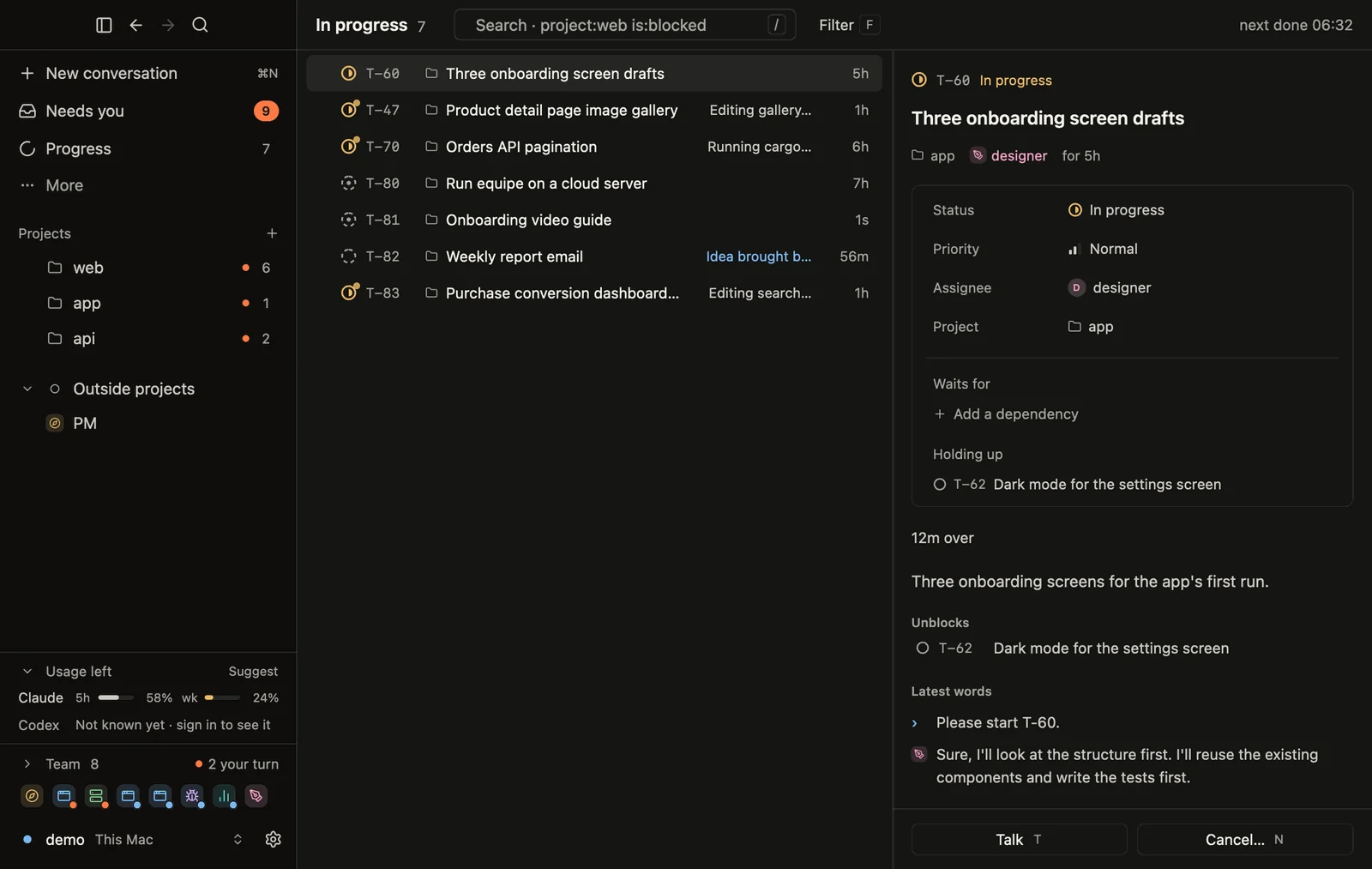
Here is the part most AI tools hide. In equipe, the team’s work lives on a board of tickets. A ticket is a small, clear piece of work with a title, an owner, a status and a history. Members coordinate through tickets, not through endless chat, so you can look at the board at any moment and see who is doing what.
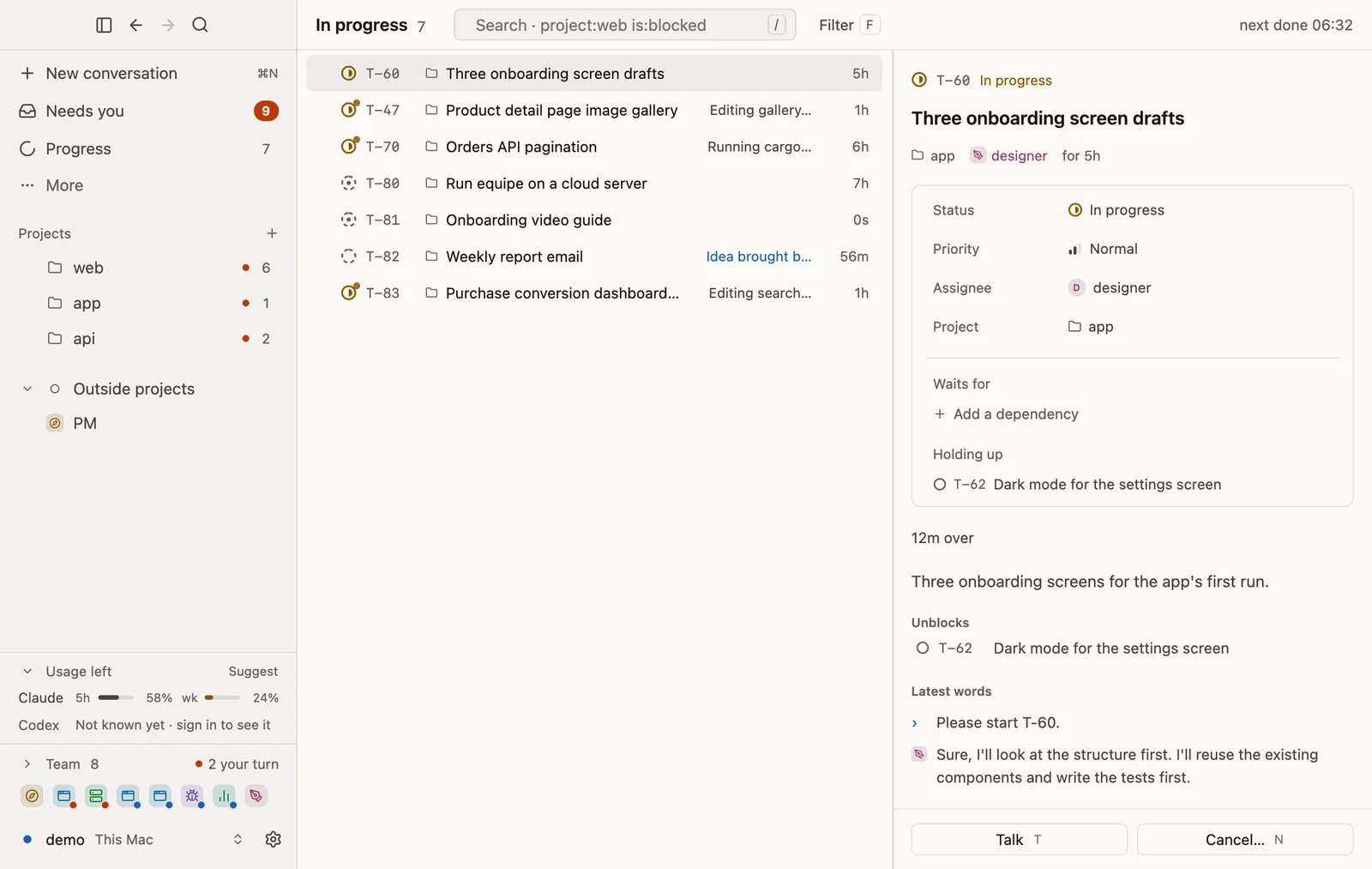
Three design decisions make this safe to follow:
- Separate workspaces. Each member works in its own copy of the project, on its own branch, so several can work at once without overwriting each other or touching your live product.
- A shared source of truth. The board and its event history are the record. If something is not on the board, it did not happen.
- Your approval at the gate. Nothing is merged into your main product until the person leading the team says so.
What the team asks of you
A good team does not drown you in questions. It brings you a short card when it needs you: what the decision is, the options, a recommendation, and the expected cost. Typical cards:
- “Allow the team to publish this version?”
- “Buy this domain for this price?”
- “Send this email to your customers?”
You answer with one tap. Anything that goes live, costs money or reaches your customers waits for your OK; that is a rule, not a setting. The details are in what approvals and secrets mean for your safety.
What the team does not do
Being honest about limits is part of trusting a team:
- It does not replace your judgment about customers. It can propose a next step from the data; it cannot know your market the way you do.
- It is not magic on a vague brief. The more clearly you say who it is for and what proves it works, the better the plan is. Our guide to launching without code starts there.
- It can be wrong. QA and your approval exist for that reason.
- Not everything is shipped. One-step import from Claude and weekly usage reports with proposals are still coming. See Turn a Claude artifact into a live app for what happens in the meantime.
What it looks like in practice
The example products on equipe.im (a habit tracker, a bilingual waitlist page, a booking page, a newsletter, a small shop) were each built and launched by an equipe team in about 35 to 45 minutes. The businesses are made up for the demo; the sites are real and live. Beyond examples, equipe is built by its own team: the website and the apps were built by equipe teams, and the site reports 222 tasks finished in 20 days with one person approving (self-reported, counted on 1 November 2026).
Should you want one?
An AI startup team makes sense when:
- you have ideas and little time or technical skill;
- you want the product to keep improving after the first version;
- you are comfortable being the decision-maker, not the doer.
It makes less sense if you enjoy writing the code yourself, or if your project is a one-evening experiment that a chat window can handle.
If it fits, you can start free, with $5 of credit and no card, and tell the PM what you want to build. The pricing page explains what team time and credits cost, and our cost breakdown walks through the numbers.